A team of agents: who does what, and who checks whom
One agent with every permission is a single point of failure. Several small ones, each with one job and its own access, are easier to trust and easier to debug. How to split the work, hand it over, and stop them agreeing with each other.
By DevOps.ae. Published 28 November 2026. 5 minute read.
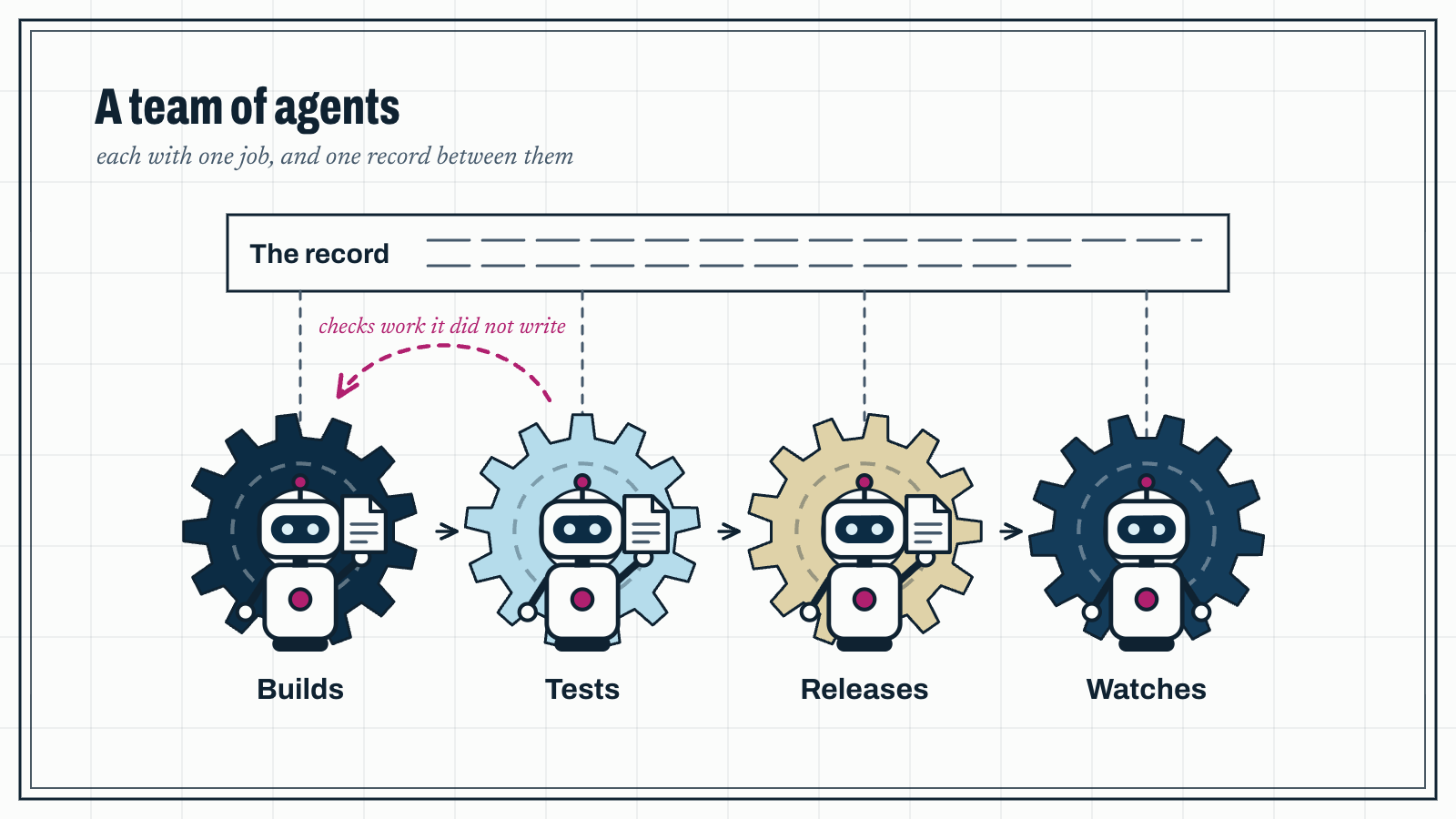
The first agent a team builds usually grows. It starts by reviewing changes. Then someone gives it access to the test environment, then to the deployment tool, then to the alerting system. A year later there is one agent that can do everything, holds every permission, and has a prompt nobody dares to edit.
That is the same mistake as the shared administrator account, made again with newer technology. The answer is the same too: split it up.
Why several small agents beat one large one
Access. An agent that only reviews changes needs to read a repository and write a comment. An agent that deploys needs far more. Put both jobs in one agent and the reviewer carries the deployer's permissions everywhere it goes.
Attention. A model works from what is in front of it. An agent holding the build logs, the test results, the deployment history and last night's alerts at once does each job worse than four agents holding one each.
Debugging. When something goes wrong, "the release agent approved a change the test agent had marked as failing" tells you where to look. "The agent did something odd" does not.
Cost. A small agent can run on a smaller, cheaper model. Only the work that needs deep reasoning has to pay for it.
Split by job, not by tool
The natural split follows the stages work already passes through. Each agent has one job, reads what that job needs, and can change only what that job produces.
| Agent | Reads | May change | Hands on to |
|---|---|---|---|
| Builds | The change, the build logs | Nothing: it comments | Tests |
| Tests | The change, test results, coverage | Test branches | Releases |
| Releases | The plan, the checks, the approval | The release, after a person says yes | Watches |
| Watches | Metrics, logs, alerts | Nothing: it reports and proposes | Builds, when it finds a fault |
Notice how few entries in the third column are real changes. Most agents in a healthy team are readers. The one that can change production does so through a gate with a person at it.
A split by tool ("the Kubernetes agent", "the Terraform agent") looks tidy and works badly, because real work crosses tools. A failed release involves both, and neither agent owns it.
One record between them
Agents should not talk to each other in private. Every handover goes through something a person can read: a comment on the pull request, a note on the ticket, an entry in the incident timeline.
This costs nothing and buys three things. A person can follow the work without asking. A handover that loses something shows up at once, because the next agent's first comment makes no sense. And when you replace one agent, the others do not notice, because they only ever read the record.
A handover is worth writing to a pattern. A good one has four parts: what was done, what was found, what was not checked, and what the next step should be. The third part is the one that prevents accidents. "I did not run the integration tests because the environment was down" is the most useful sentence an agent can write.
A different agent checks
An agent reviewing its own work will usually find it good. It has the same instructions, the same blind spots and the same context that produced the mistake.
So the check belongs to a different agent, set up differently:
- It sees the result, not the reasoning that led to it.
- It has its own instructions, written to find faults, not to finish the job.
- Where the work matters, it runs on a different model, so the two do not share a model's habits.
Then test the checker. Every so often, give it a change with a fault you planted: a deleted backup rule, a widened firewall. A checker that passes a planted fault is not checking, and you want to learn that from a drill.
How a team of agents goes wrong
These failures are specific to having more than one, and each has a plain remedy.
The polite loop. Two agents pass work back and forth, each improving the other's wording, for forty rounds. Remedy: a limit on rounds, after which the work goes to a person.
Easy agreement. A reviewer that approves everything. Remedy: the planted faults above, and a count of how often it disagrees. A reviewer that never disagrees is decoration.
The runaway bill. Each agent calls the next, and a small job turns into two hundred model calls. Remedy: a budget for every agent and every job. When it is spent, the agent stops and says so.
The lost fact. The build agent knew the change touched the payment service. The release agent was never told. Remedy: the written handover, with its "what was not checked" line.
Nobody's agent. An agent whose owner changed teams. Remedy: every agent has an owner by name, on the same list as your services.
When one agent is enough
Most teams should start with one agent and one job, and stay there until there is a reason to change. There are two good reasons to add a second.
The first is a boundary of access: the new work needs permissions the first agent should not have. The second is a boundary of attention: the first agent's results get worse as its instructions get longer.
"It would be more elegant" is not a reason. Every agent you add is another thing to test, pay for and own. A team of four that each do one job well is a good system. A team of twelve is usually a diagram.
If you are deciding where the lines should fall in your own delivery process, that is the design step of our agent service, and we are glad to talk it through.